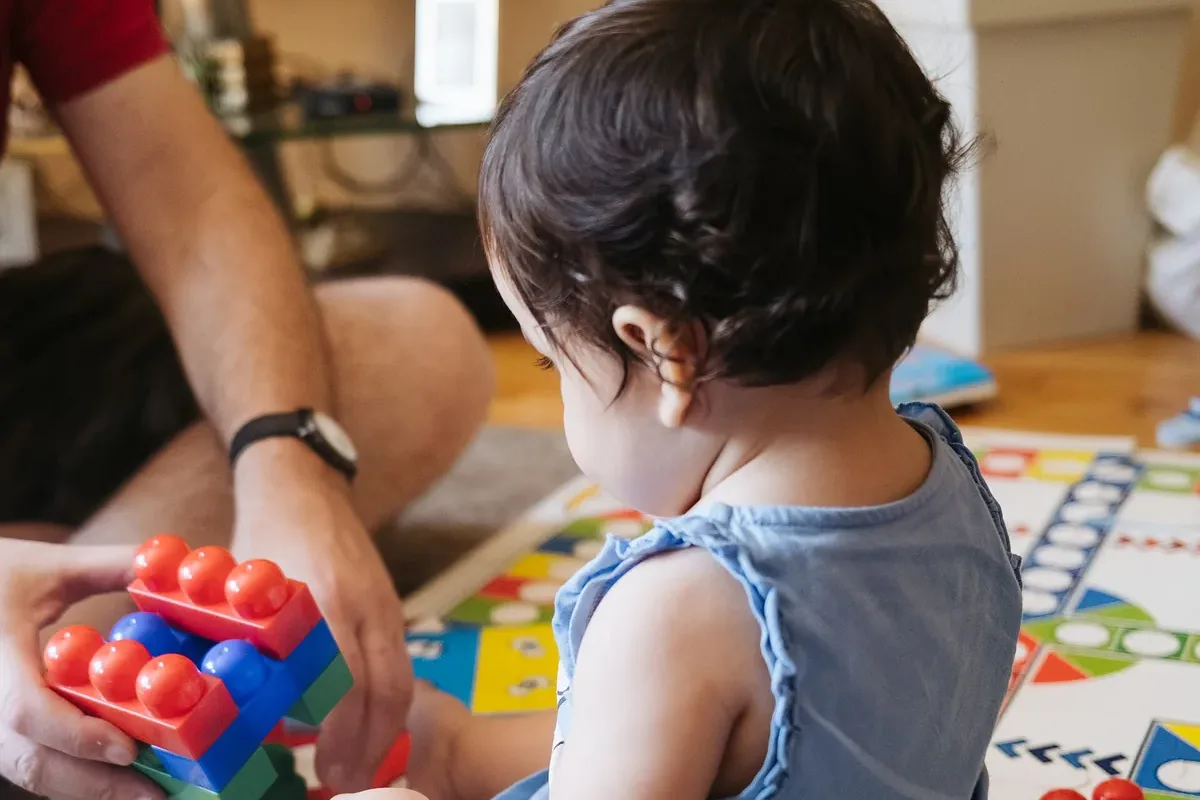
The Best Toys for 3-Year-Olds That Survive Past January
Every December, a 3-year-old gets a pile of toys. By January, they're playing with about three of them and the box one came in. The best toys for 3-year-olds are the ones in that group of three, and after enough holidays I've noticed they have a lot in common: they don't do much on their own, so the kid has to do the work.
That's the filter for this list. Every pick is open-ended (it can be a different thing every day), sturdy enough for a kid who throws things to see what happens, and something a 3-year-old can use without an adult reading instructions. Prices run from about $21 to $77 as of today, and they update daily so you're not guessing.
If your kid is younger, my best toys for 1-year-olds guide is the better fit. And if you're worried about the toy avalanche in general, read how many toys a toddler actually needs before you buy anything. Spoiler: fewer than you have.
Best Toys for 3-Year-Olds: Quick Picks
"Ages" is the manufacturer's label. Pick by what your kid already does when nobody's directing them: builds, plays pretend, rides, or listens.
| Toy | Type | Ages | Price | Best For |
|---|---|---|---|---|
| Magna-Tiles Classic 32 | Building | 3+ | $34.99 | Open-ended daily play |
| PicassoTiles 60 | Building | 3+ | $20.99 | Magnetic tiles on a budget |
| LEGO DUPLO Deluxe Box | Building | 1.5+ | $49.99 | A toy siblings inherit |
| KidKraft Vintage Kitchen | Pretend play | 3+ | See price | The big gift |
| Melissa & Doug Cutting Food | Pretend play | 3+ | $24.99 | Play kitchen add-on |
| Melissa & Doug Doctor Kit | Pretend play | 3+ | $20.99 | Checkup nerves |
| Sneaky, Snacky Squirrel | Game | 3+ | $23.28 | First board game |
| Yoto Mini Bundle | Audio | 3+ | $75.99 | Screen-free stories |
| Radio Flyer Red Rider Trike | Active | 2.5 to 5 | $48.34 | Learning to pedal |
| BRIO Starter Travel Train | Building | 3+ | $41.99 | Train fans |
Prices as of Nov 20, 2026, 5:48 PM UTC. Product prices and availability are accurate as of the date/time indicated and are subject to change. Any price and availability information displayed on Amazon.com at the time of purchase will apply to the purchase of this product.
What Do 3-Year-Olds Actually Play With?
Three is a big jump from two. A few things change that should shape what you buy:
- Pretend play gets real. Two-year-olds copy what you do. Three-year-olds run whole scenes with characters, problems, and a plot that makes sense only to them. Kitchens, doctor kits, trains with passengers, and dolls all get a lot more use now.
- Hands get steadier. Lining up edges, connecting track, squeezing a tool, and building up instead of just knocking down are all suddenly possible. That's why building toys jump to the top of the list at this age.
- Rules start to work. Very simple games with turns and one rule are doable, for about 15 minutes, with a dad who is willing to lose on purpose sometimes.
- Bodies want to move. Pedaling, climbing, and running are a big deal. A ride-on toy beats most indoor gadgets for burning energy before dinner.
What fades: shape sorters, push toys, and anything that mostly plays a song when a button gets pressed. If those are still around from the toddler years, it's a good time to rotate them out or pass them on.
The 10 Best Toys for 3-Year-Olds
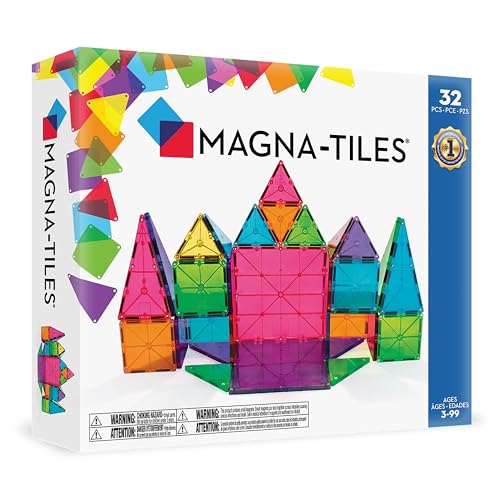
1. Magna-Tiles Classic 32-Piece Set: Best Overall
- 32 translucent tiles in 6 colors
- 16 squares (2 large, 14 small) and 16 triangles in 3 shapes
- Labeled for ages 3 and up
- Works with other Magna-Tiles sets, so it grows
If I could only buy one toy for a 3-year-old, it would be magnetic tiles. They do the thing every good toy does at this age: they're different every time. On Monday it's a garage for cars. On Wednesday it's a rocket. On Saturday it's a "house for the dog," and the dog is not consulted.
Three is the age when kids can finally line up edges and build up instead of just knocking down, and tiles reward that fast. The magnets do half the work, so a kid gets a tall tower before frustration kicks in. They also stretch: kids in kindergarten and first grade still play with them, which is rare for anything bought at 3.
The honest complaints: 32 pieces is a starter amount, and most families end up buying a second set within a year once real builds start. The original brand also costs more per tile than knockoffs. Parent forums are full of the same trade-off: cheaper sets often have weaker magnets, while the originals hold up for years of daily use. Check every set now and then for cracked tiles, and toss any with a crack, because loose magnets are a real swallowing hazard.
- Open-ended, used daily for years
- Strong magnets make building less frustrating
- Expands with any Magna-Tiles set
- 32 pieces runs out fast for big builds
- Pricier per tile than knockoffs
- Cracked tiles must be retired right away
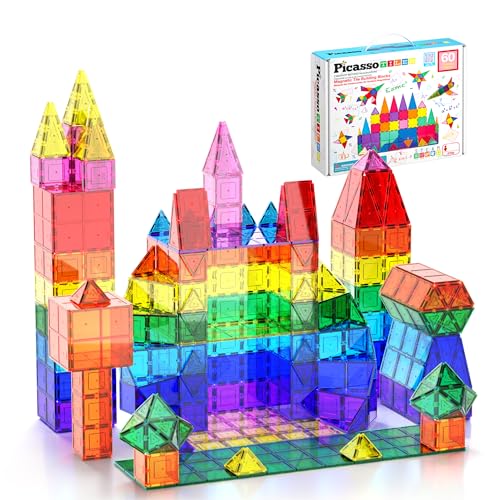
2. PicassoTiles 60-Piece Magnetic Tiles: Best Budget Pick
- 60 clear, colored magnetic tiles
- Labeled for ages 3 and up
- BPA-free plastic, per the listing
- Connects with full-size PicassoTiles sets
Same idea as Magna-Tiles, nearly twice the pieces, usually for less money. For a kid who has never seen magnetic tiles, this is a very reasonable way to find out if they'll love them before you spend more.
Owners who have both brands tend to say the same thing: PicassoTiles are a little thinner and the magnets are a bit weaker, so tall towers wobble sooner. For a 3-year-old building garages and walls, that rarely matters. Mixing brands works physically in most cases, but the sizes don't always line up perfectly, so I'd pick one brand and stick with it.
- More pieces for the money
- Same open-ended play
- Good test before a bigger buy
- Slightly weaker magnets than the original
- Tile sizes may not match other brands exactly
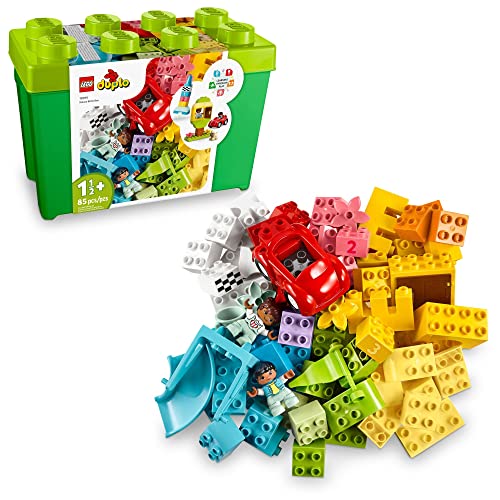
3. LEGO DUPLO Deluxe Brick Box 10914: Best Building Bricks
- 85 DUPLO pieces including a car, window, people, and 1-2-3 number bricks
- Stores in its own lidded box with a buildable top
- Labeled for ages 1.5 and up
- Compatible with every DUPLO set and with standard LEGO bricks on top
DUPLO is the toy most likely to still be on the floor in five years, just with more scratches. At 3, kids move from stacking to actually building things with a purpose: a house, a tower for a figure, a car with a roof that keeps falling off. The bricks are big enough that small parts aren't a concern and sturdy enough to survive being stepped on, which I can tell you from the parent side of that equation hurts the parent more than the brick.
The Deluxe box is the one to get over the smaller 10913 box because 85 pieces is enough for two kids or one kid and a dad. The box itself matters too: everything goes back in one container, which is half the battle at cleanup time.
- Nearly indestructible
- Works with sets you already own or get later
- Built-in storage box
- Some kids prefer magnetic tiles and ignore bricks
- Specialty pieces sold in themed sets, not here

4. KidKraft Vintage Wooden Play Kitchen: Best Big Gift
- Wooden kitchen with fridge, freezer, microwave, oven, and cabinets
- Clicking oven knobs, pretend ice maker, play phone
- Doors open and close with handles
- Retro white finish
Pretend play takes off around 3, and a play kitchen is where most of it happens. You will be served a lot of plastic soup. You will be asked to pay for it. You will be told it's too hot.
This one is a good middle ground: sized for a 3-year-old, made of wood instead of thin plastic, and not one of the giant corner units that eat half a playroom. The doors and knobs give kids something to do with their hands while the story plays out.
The complaint you will see over and over on wooden play kitchens, this one included, is assembly. Plan for an evening, a screwdriver, and patience, and do not start it at 11 p.m. on Christmas Eve. Some owners also mention that the finish chips if it gets banged hard. Accessories are not included beyond the phone, so pair it with play food (next pick).
- Pretend play center for years
- Wood, not flimsy plastic
- Compact footprint for a kitchen
- Long assembly
- No food or pots included
- Finish can chip

5. Melissa & Doug Cutting Food Set: Best Add-On Under $25
- Painted wooden food pieces held together with self-stick tabs
- Wooden knife and cutting board included
- Pieces "crunch" apart when sliced
- Introduces whole and parts (halves, pieces)
The cutting food set is the cheapest way to make a play kitchen ten times better, and it works fine without one. Kids at 3 love the satisfying slice-and-separate moment, and it sneaks in a little early math: two halves make a whole.
The most common owner complaint is that the sticky tabs lose grip over time and the food stops holding together as well. That happens after a lot of use, and the pieces still work as regular play food afterward.
- Inexpensive and durable wood
- Fine motor practice with the knife
- Pairs with any play kitchen
- Sticky tabs wear out eventually
- Small set, pieces wander

6. Melissa & Doug Get Well Doctor Kit: Best Pretend Play Under $25
- 25-piece set
- Stethoscope, blood pressure cuff, thermometer, syringe, hearing tester, and more
- Everything packs into a carry tote
- Labeled for ages 3 and up
A doctor kit is one of those toys that seems silly until you watch a 3-year-old use it to process their own checkup. They give the stuffed bear a shot, tell it to be brave, and give it a sticker. That's a kid working through something, and it can make the real pediatrician visit easier.
It is also a dad toy in the best sense: you get to lie on the couch while being examined. Repeatedly. For a long time.
Downsides are the usual ones for 25-piece sets: little pieces scatter, and the plastic stethoscope isn't the sturdiest thing on this list. The tote helps more than you'd think.
- Big pretend-play value for the price
- Helps with doctor-visit nerves
- Tote keeps pieces together
- Small pieces go missing
- Plastic parts are light-duty
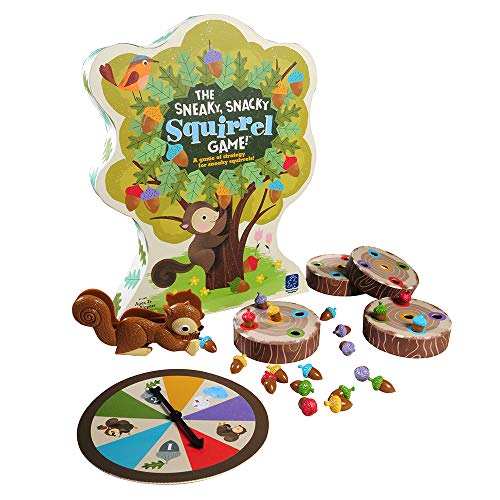
7. The Sneaky, Snacky Squirrel Game: Best First Board Game
- For 2 to 4 players, ages 3 and up
- Squirrel-shaped squeezer tool picks up acorns
- 20 acorns in 5 colors, spinner, 4 logs
- Tree-shaped board doubles as the box
Three is when kids can play a real game with rules, as long as the rules are short and nobody has to read. Spin, match a color, grab an acorn with the squeezer. That's the whole thing, and it's genuinely fun for 15 minutes, which is about how long a 3-year-old will sit anyway.
The squeezer is the secret: it's fine motor practice disguised as a game. The bigger lesson is losing. Somebody spins the windstorm and loses their acorns, and learning to survive that at 3 is worth a lot later.
Owners say it gets boring for adults quickly and for kids around age 5. That's fine. It's a first game, not a forever game.
- Rules a 3-year-old actually follows
- Fine motor practice built in
- Teaches turn-taking and losing
- Outgrown by about 5
- Acorns are small enough to lose

8. Yoto Mini Starter Bundle: Best Screen-Free Audio
- Plays stories and music from physical cards a kid inserts
- Up to 14 hours per charge, per the listing
- No camera, no microphone, no ads
- Doubles as a night light, OK-to-wake clock, and Bluetooth speaker
The Yoto Mini solves a real problem: how to give a 3-year-old control over their own entertainment without handing them a screen. They pick a card, push it in, and a story plays. Pull it out and it stops. That's it. Kids feel independent and you get quiet time in the car or before bed.
It's also a decent OK-to-wake clock, which matters at this age, and the bundle comes with a starter set of preschool cards so it's usable on day one.
The common complaint is cost over time. The player is the cheap part; the cards add up, and individual cards cost more than the same audiobook would on an app. Yoto offers free content in its app, and a few favorite cards go a long way, but go in knowing that.
- Truly screen-free, kid-controlled
- No mic or camera
- Works as a clock and night light too
- Cards add up fast
- Pricier than a basic speaker
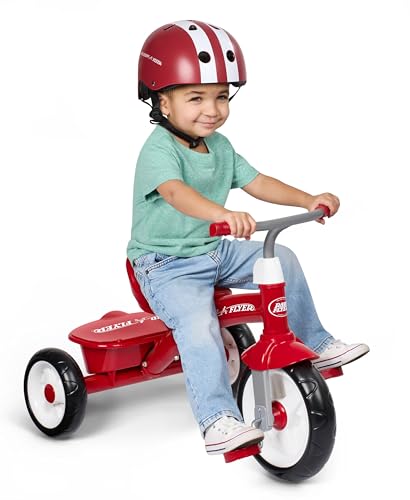
9. Radio Flyer Red Rider Trike: Best Ride-On
- Steel frame
- Adjustable seat for ages 2.5 to 5
- Quiet-ride wheels and comfort-grip handlebars
- Covered storage bin and a seat-back carry handle
Pedaling is a big 3-year-old milestone, and a classic trike is the easiest way to get there. The steel frame is why this one survives being left in the driveway, and the storage bin turns every ride into a mission to transport rocks.
The carry handle on the seat back is a dad detail I appreciate: lifting a trike and a kid over curbs gets old, and this makes it one hand instead of two.
Owner gripes are mostly about the seat on the smallest setting still being a reach for younger 3s, and about the tires being hard plastic, so it's loud on rough pavement despite the "quiet" label. If your kid is already confident on a balance bike, they may find a trike slow.
- Sturdy steel build
- Grows from 2.5 to 5
- Storage bin and carry handle
- Hard tires on rough pavement
- Some younger 3s can't reach the pedals yet

10. BRIO World Starter Travel Train Set: Best Wooden Train
- 22 pieces
- Figure-8 track with tunnel and bridge crossing
- Station platform and train with driver, passenger, and luggage
- Labeled for ages 3 and up; works with all BRIO track
Wooden trains hit a sweet spot at 3: kids can finally connect track themselves, and they're old enough to run a whole story with a driver, passengers, and a train that is "late, very late."
This starter set is the right size to begin with, and every BRIO piece connects to every other BRIO piece, so birthdays and grandparents have an easy gift list for the next three years. Many store brands also fit the same track, which keeps expansion cheap.
The common complaint is the obvious one: the starter loop is small, and kids want more track almost right away. That's the business model. Budget for an expansion pack later.
- Kids can build and rebuild the layout
- Compatible with tons of track
- Wood that survives younger siblings
- Starter loop is small
- More track costs more money
Which Toys Should You Skip for a 3-Year-Old?
Some toys look great in the store and are in the donate pile by spring:
- Toys that do the playing. If the toy talks, sings, and lights up when touched, the kid's job is pressing a button. These get a big reaction on day one and very little after that.
- Huge themed playsets with 80 tiny pieces. At 3, most of those pieces end up under the couch within a week. If you love a set, put most of the pieces away and hand them out a few at a time.
- Anything licensed just for the character. The show your kid loves in November may be over by March. A plain train set outlasts the cartoon train set.
- Toys aimed at 5 and up "so they can grow into it." That label is usually about small parts or skill level, not just interest. More on that below.
Stocking-sized stuff counts too. My list of stocking stuffers for toddlers under $25 sticks to small things that get used, not plastic that gets stepped on.
Are Toys Labeled 3+ Safe for a Just-Turned-3?
Mostly yes, but read the label for what it's actually telling you. Under federal rules, toys intended for children under 3 can't contain small parts that a young child could choke on. Toys meant for kids 3 to under 6 that do contain small parts have to carry a "CHOKING HAZARD" warning instead. So a 3+ label often means "this has small parts," not "this is too advanced."
That matters most when there's a younger sibling in the house. The 3-year-old may be fine with acorn game pieces; the 1-year-old crawling behind them is not. Keep small-part toys at a table or in a room the baby can't reach, and do a pickup sweep after play. Magnet toys get one more rule: check magnetic tiles for cracks every so often, and throw out any cracked tile, because swallowed magnets can cause serious internal injuries.
How Many Toys Should a 3-Year-Old Get for Christmas?
Fewer than the grandparents would like. One bigger gift (a kitchen, a trike, or a train set), one or two smaller ones, and a book is plenty from parents. If a lot of toys are coming in from family, it's fine to keep a few in the closet and rotate them in over the winter, when the novelty is worth more. I'd also point gift-happy relatives toward expansions of what you already own, like more Magna-Tiles or more train track, which keeps the toy count down and the play value up.
And if your kid ignores all of it and plays with the wrapping paper and a wooden spoon, that's not a failure. It's normal, and I wrote about why kids play with non-toys if you need reassurance.
Frequently Asked Questions
What is the best toy for a 3-year-old?
An open-ended toy that can be used a different way every day. Magnetic tiles like Magna-Tiles top most lists, including this one, because 3-year-olds can build with them right away and kids keep using them into grade school. A play kitchen, DUPLO bricks, or a wooden train set are strong alternatives depending on whether your kid leans toward pretend play or building.
What toys help a 3-year-old's development?
Building toys (tiles, bricks, train track) work hand control and spatial skills. Pretend-play toys (kitchens, doctor kits) build language and social skills because kids narrate and act out scenes. Simple games teach turn-taking and losing, and ride-on toys like trikes build coordination. You don't need anything labeled "educational" to get those benefits.
How much should I spend on a toy for a 3-year-old?
You don't need to spend a lot. Most of the picks here land between about $21 and $77 as of this writing, and the cheapest options (a doctor kit, a cutting food set, or a first board game) get as much use as the expensive ones. A good rule is to spend on the one thing they'll use every day and keep everything else small.
Is a tricycle or balance bike better for a 3-year-old?
Both work. A tricycle teaches pedaling and suits kids who want to cruise and carry stuff. A balance bike teaches balance, which can make the move to a pedal bike easier later. If your kid already rides a balance bike well, skip the trike; if they've never ridden anything, a trike is an easy first win.
The Short Version
- Best toy for 3-year-olds overall: Magna-Tiles Classic 32-Piece Set, 32 magnetic tiles that kids keep using into grade school.
- Best budget pick: PicassoTiles 60-Piece, nearly twice the tiles for less money, with slightly weaker magnets.
- Best big gift: KidKraft Vintage Wooden Play Kitchen; plan an evening for assembly and add a play food set.
- Best under $25: Melissa & Doug Get Well Doctor Kit (25 pieces) or The Sneaky, Snacky Squirrel Game for 2 to 4 players.
- Best screen-free pick: Yoto Mini, with up to 14 hours of audio per charge and no camera or microphone.
- Toys labeled 3+ often contain small parts, so keep them away from younger siblings.
Sources and Further Reading
The Bottom Line on the Best Toys for 3-Year-Olds
The best toys for 3-year-olds don't do much by themselves. Get one great open-ended toy, Magna-Tiles if you're unsure, then add one thing that fits how your kid already plays: a kitchen for the chef, a train for the kid who lines up cars, a trike for the one doing laps around the coffee table. Skip the toy that sings when you poke it. It will be in the closet by Valentine's Day, singing to nobody.
Affiliate + Accuracy Disclosure
As an Amazon Associate, I earn from qualifying purchases. Product specs, pricing, and availability can change. Please verify current details on Amazon before buying. Recommendations are based on published specs, owner feedback, and practical dad-focused use cases.