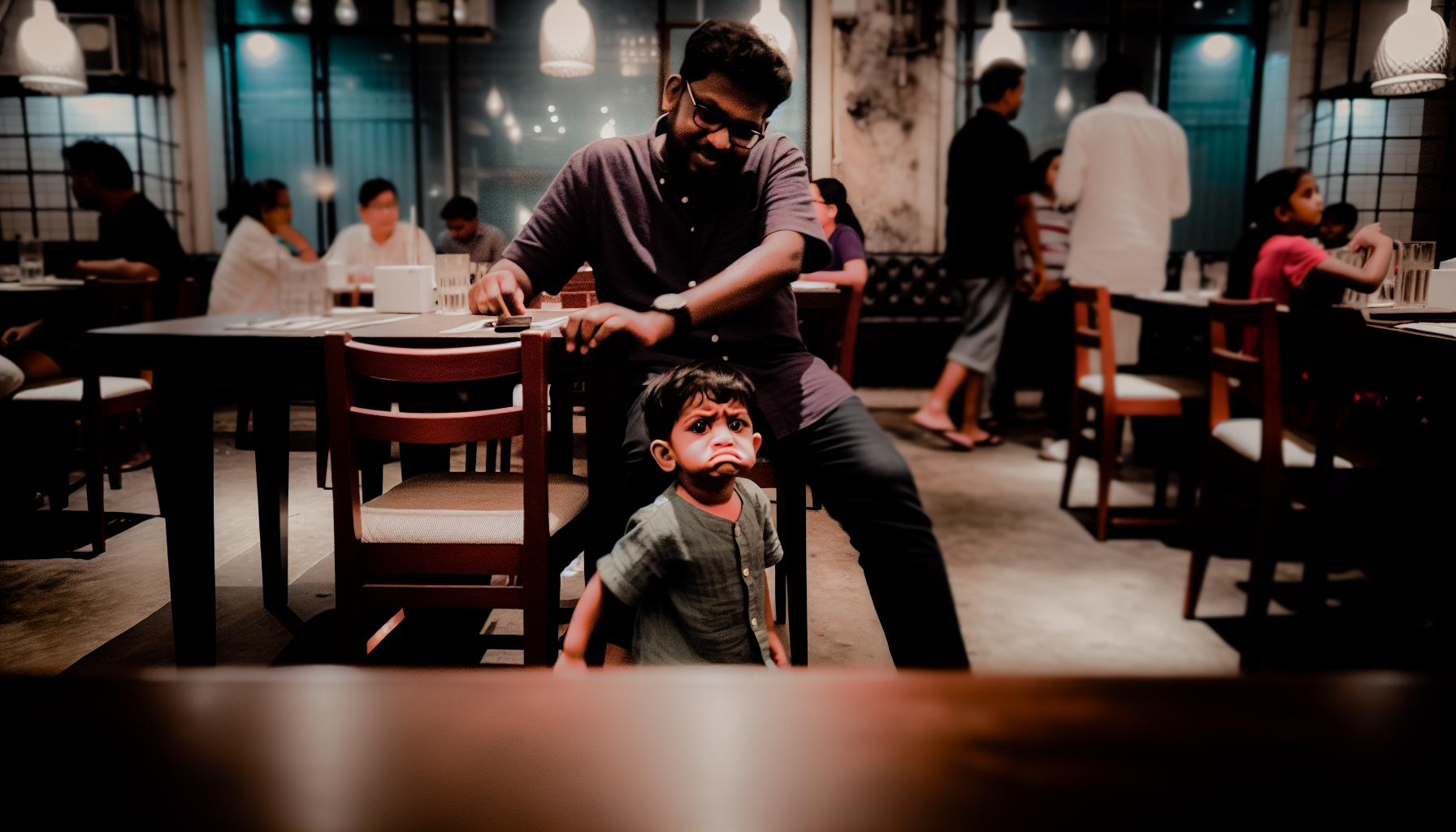
My Kid's First Full Restaurant Meltdown (A Dad's Play-by-Play)
The reservation was for 6:30. I had a plan. A complete, foolproof, this-will-definitely-work plan. Snack in the car so nobody arrived on empty. Arrival before the restaurant got loud and overwhelming. A small bag with a coloring book and two crayons. And the most important piece: a firm, pre-emptive talk in the parking lot about how we were going to behave in the restaurant like a civilized family. I had covered every angle. I was confident in a way only someone about to be proven wrong can be.
We were three bites into the bread basket when the wheels started to come off.
The Setup: How We Got There
This was not a casual Tuesday pizza night. This was a birthday dinner for my wife's mom. Nice-ish restaurant. White tablecloths. Other people's grandparents seated close enough to hear everything. My kid was two-and-a-half, recently decided sleep was optional, and had skipped an afternoon nap for the third day in a row. I knew the risk. I went anyway. This is the part where experienced parents are shaking their heads right now.
Everything held together beautifully for about twelve minutes. Bread was consumed. Crayons were deployed. I was beginning to think maybe I had finally cracked the code on public behavior. Then the hostess seated a family with a dog at the outdoor section visible from our table, and my kid spotted it. And that was the beginning of the end.
"Dog. Dog. DOG. I want to pet the dog."
The dog, for the record, was outside behind a glass partition and approximately forty feet away. Petting the dog was not a realistic option. I explained this. My explanation was not well-received.
The Play-by-Play
The request to pet the dog begins. Polite at first. I redirect with the coloring book. Coloring book is pushed aside. I try pointing at the bread basket. Bread is not a dog. This is made very clear to me.
The dog disappears from view. This is catastrophic. My kid stands up in the booth, trying to locate the dog. I sit them back down. They stand back up. I sit them down again. We do this three times before the people at the table behind us start noticing.
The coloring book gets swept off the table. Not violently, just purposefully, the way a tiny person communicates that crayons are not the point. The crayons hit the floor. I pick them up. My kid starts crying. Not soft, polite tears. The kind of crying that arrives with sound effects and involves the whole body.
I start negotiating. "If you stop crying, you can have a dessert." No response except louder. I try explaining why we can't pet the dog right now, using complete sentences, as if this is a matter of logistics that can be reasoned through. My kid is not in a reasoning state. I know this. I try anyway. Classic mistake.
I pick up my kid and excuse myself from the table. I take us outside. Not to the parking lot, just away from the dining room, near the host stand, where there's a little more space and a lot less audience. This is the move I should have made at minute two.
Outside, without the audience, without the noise of the restaurant, without me trying to salvage the evening at full speed, things start to slow down. I crouch down. I stop talking. My kid cries for another couple of minutes while I just stay close and keep my mouth shut. Eventually the volume drops. I don't celebrate this. I don't say "see, that's better." I just wait.
We walk back in. I give my kid a job: carry the crayons back to the table. We sit down. I order something off the kids menu that I know will arrive fast. The rest of the dinner is not perfect, but it's functional. Nobody gets dessert, including me. But we finish. We tip well. We leave.
What I Did Wrong
I negotiated. The moment you offer a dessert bribe to a two-year-old mid-meltdown, you have already lost, and also you have just taught them that meltdowns are a transaction system. I did this knowing better and did it anyway, because I was embarrassed and trying to get things under control fast. That impulse, speed over strategy, is the enemy.
I also waited too long to take the walk. I stayed at the table trying to quietly manage the situation in place, which meant my kid was melting down in front of an audience while I got increasingly tense. The tension made everything worse. The walk should have happened at the first sign of escalation, not after we'd hit full volume.
And I tried to reason through it. Explaining logistics to a sleep-deprived two-year-old having a big feeling is like reading the terms of service to someone whose hair is on fire. They cannot hear you. They are not in the reasoning part of their brain. Save the debrief for after.
What Actually Worked
Getting physical distance from the audience changed everything. The moment it was just the two of us in a quieter spot, my own stress dropped about fifty percent, and I think my kid felt that. Kids are weirdly calibrated to parental anxiety. If you're locked up and tense, they tend to stay wound up longer. When I stopped performing calm for the table and started actually feeling calmer, the situation shifted.
Silence also worked. Not the loaded silence of a parent who is mad and waiting for someone to apologize, but just quiet presence. I didn't leave. I didn't lecture. I didn't comfort in that slightly fake way that sounds like "there there, let's move on." I just stayed nearby and let the feeling pass at whatever speed it was going to pass at.
The job on the way back in helped too. Giving my kid something small to be responsible for, carry the crayons, hold the menu, pour their own water, snaps them into a different mental mode. It gives them a reason to re-engage instead of needing to save face somehow.
5 Things I Do Differently Now
Dad-Tested Restaurant Survival Tips
The Part Nobody Talks About
The embarrassment is real and worth naming. When your kid is on the floor of a nice restaurant while other adults are trying to have a pleasant dinner, the shame spiral is immediate. You start cataloging everything you did wrong, everything you should have done differently, and wondering if the table next to you is going to talk about you on the drive home.
Here's what I've come to understand: most parents at other tables are not judging you. They are either relieved it's not them tonight, or they've been exactly where you are and they know what it feels like. The ones who look annoyed are either pre-kids or they've forgotten. Neither group's opinion matters much to me anymore.
What matters is how you handle it, not whether it happens. Taking the walk is a good call. Staying regulated enough to not make it worse is a good call. Finishing the meal and tipping your server well is also a good call, because your server absolutely earned it.
My kid is older now and restaurant dinners are genuinely easier. We still have moments. But that first full restaurant meltdown, the one I thought might actually end me, turned out to be a pretty useful education. Cheaper than most parenting courses. Slightly louder.